Call Us NowEmail Us Now

Back to All Blogs

blog-authorDavid A. Keller, Esq.

Hero Image

EB-1C Request for Evidence: How Employers Should Respond
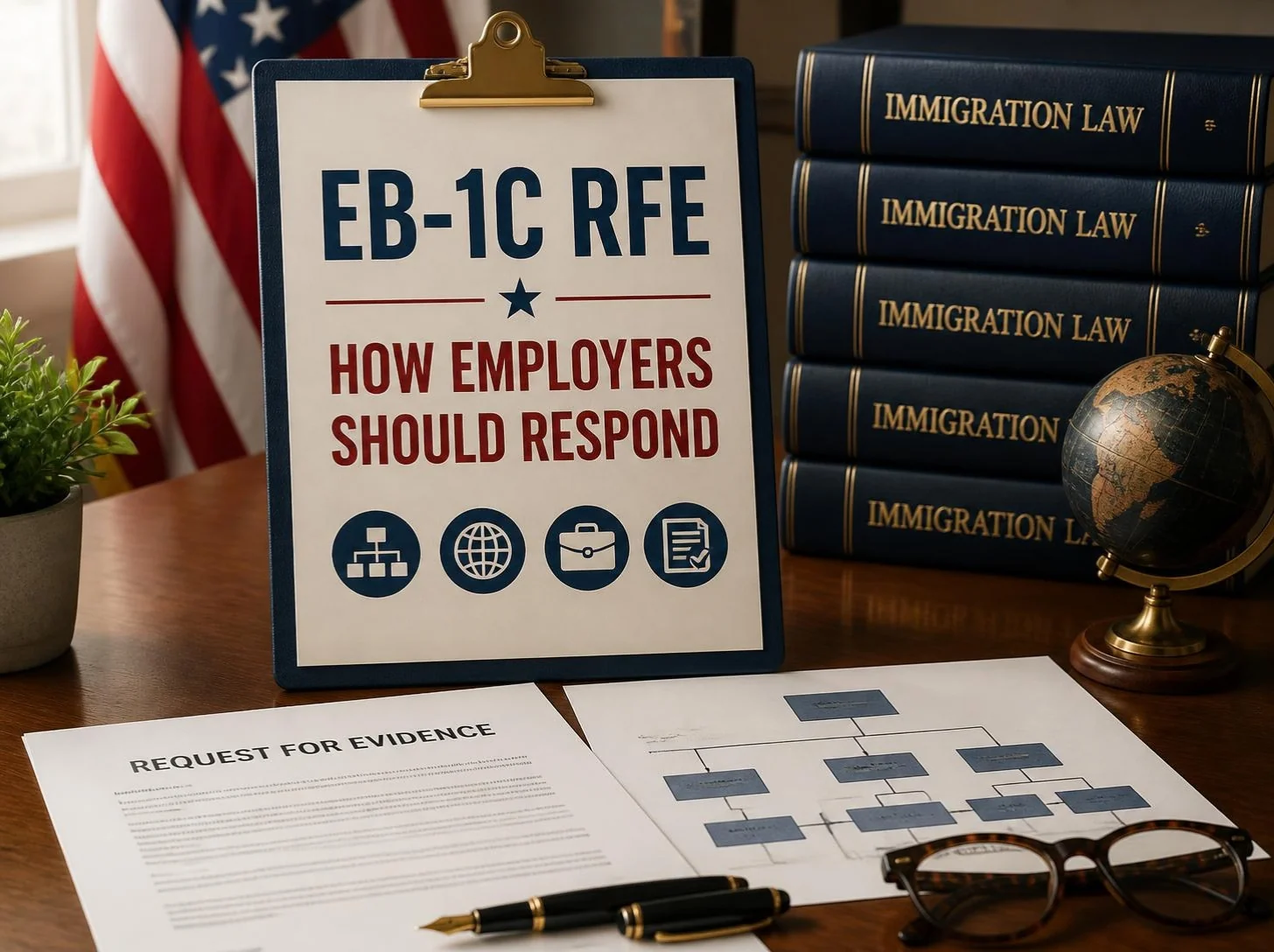
EB-1C Request for Evidence letter and corporate organizational chart on an immigration attorney's desk
The EB-1C category lets a multinational company sponsor a manager or executive for a green card without going through PERM labor certification. It is also one of the more dependable employment-based categories. USCIS data for the first three quarters of fiscal year 2026 shows roughly 9,400 EB-1C approvals against about 275 denials.

Those numbers hide a lot of stress, though. Plenty of approved cases got there only after a Request for Evidence (RFE) or a Notice of Intent to Deny (NOID). Neither one is a denial. Both are a signal that the record, as filed, does not yet prove eligibility. And since August 2026, employers have less time and less room for error when they answer one.

What Changed on August 5, 2026

USCIS Policy Alert PA-2026-05 rewrote the agency’s guidance on evidence, RFEs, and NOIDs. It took effect immediately for cases pending or filed on or after August 5, 2026. For EB-1C employers, four changes stand out:
  • Denials without a warning — officers once again have full discretion to deny a petition that is missing required initial evidence, without first issuing an RFE or NOID.
  • Shorter response windows — 12 weeks is now the maximum for an RFE, not the default, and a NOID allows no more than 30 days. Practitioners are already seeing RFEs with roughly 30 days to respond.
  • No extra time — the regulations do not allow extensions. Mailed notices get 3 additional days, and the old 14-day cushion for notices mailed abroad is gone.
  • One shot at the response — USCIS treats any response, even a partial one, as a request for a decision. Sending evidence in pieces is no longer an option.

The practical takeaway: the original I-140 filing has to be complete, and when an RFE does arrive, the clock is shorter than many HR teams expect. You can read the full USCIS policy alert here.

What USCIS Needs to See in Every EB-1C Case

Nearly every RFE traces back to one of the core EB-1C requirements. The petitioning employer must establish that:
  • The beneficiary worked abroad for a qualifying entity, in a managerial or executive capacity, for at least one year within the relevant three-year period.
  • The U.S. position is managerial or executive.
  • The U.S. and foreign employers share a qualifying relationship (parent, branch, subsidiary, or affiliate), and the organization does business in at least two countries, one of them the United States.
  • The U.S. employer has been doing business for at least one year.
  • The employer can pay the offered wage from the priority date onward.

The three-year window depends on where the beneficiary is. If they are outside the United States, it covers the three years before the petition is filed. If they are already here working for the same employer or a related company, it covers the three years before they entered as a nonimmigrant.

RFE Trigger #1: A Managerial Title on an Operational Job

Titles like director, vice president, or general manager carry little weight by themselves. USCIS looks at what the person actually does, how the organization is structured, who reports to them, and what the business does.

The classic problem is a job description that reads like a doer rather than a manager. Duties built around words like “collaborate,” “support,” “coordinate,” and “execute” tell the officer the beneficiary performs the work. Duties that show the beneficiary approving, hiring, allocating budget, and setting direction, and that are backed by records, tell a very different story.

A few rules to keep in mind:
  • A first-line supervisor generally does not qualify as a manager unless the employees being supervised are professionals.
  • A function manager, someone who manages an essential function rather than a team, must identify the function, show why it matters to the organization, and show that they manage it at a senior level instead of performing it.
  • A non-managerial title is not fatal if the duties and evidence show genuine managerial authority.

RFE Trigger #2: A Foreign Role That Isn’t Documented

The job abroad needs the same depth of proof as the U.S. position. Officers typically want the beneficiary’s duties, the foreign company’s organizational chart and reporting lines, the people or function they managed, staffing levels, subordinates’ duties and salaries, payroll records, and evidence of senior-level authority.

One misconception is worth correcting directly: a prior L-1A approval does not settle the EB-1C case. It can be useful context, but USCIS decides the green card petition on its own record.

RFE Trigger #3: Documents That Don’t Agree With Each Other

Inconsistency is one of the fastest ways to earn an RFE. Picture an organizational chart showing eight direct reports while payroll lists five, or a job description saying the beneficiary “oversees regional sales” when the sales director reports to someone else. Each mismatch gives the officer a reason to doubt the rest of the file.

The usual trouble spots are headcounts, employee titles, reporting lines, and company names or letterhead that differ from one document to the next. The answer is not to leave unfavorable records out. It is to find the discrepancy and explain it, with evidence, before the officer does.

RFE Trigger #4: An Unclear Corporate Relationship

The petition must prove the qualifying relationship between the U.S. employer and the foreign company where the beneficiary worked. Depending on the structure, helpful evidence can include:
  • Formation and ownership records, such as articles, share certificates, and stock ledgers
  • Acquisition, merger, or reorganization documents
  • Consolidated financial statements or tax filings
  • Regulatory filings that show ownership and control
  • Proof that both entities are still operating

Corporate restructurings that happen between the original L-1 filing and the I-140 are a frequent source of problems. If the ownership chain has changed, document every link in it.

RFE Trigger #5: Ability to Pay

Ability to pay is a separate question from whether the beneficiary is a multinational manager or executive. The employer must show it can pay the offered wage from the priority date forward, usually through federal tax returns and schedules, annual reports, audited financial statements, or payroll records showing the wage is already being paid.

Organizations that do not file traditional U.S. corporate income tax returns, including some financial institutions, need extra records and a clear explanation. And do not assume the financial evidence that worked in an earlier petition will satisfy this one. Answer the specific request in the RFE.

Know Your Deadline

  • The notice controls — read the RFE the day it arrives and calendar the exact due date printed on it.
  • It is a receipt deadline — your response must reach USCIS (or be submitted online) by the due date. Mailing it that day is not enough.
  • Extensions are not available — plan around the deadline you were given.
  • Weekends and holidays — if the due date falls on one, confirm the current USCIS filing rules instead of assuming the next business day counts.
  • Follow the instructions — send the response where the notice says and include a copy of the RFE if the notice asks for it.

With 30-day windows now in play, aim to file well before the deadline, not on the last day.

How to Build a Strong EB-1C RFE Response

1. Map every request against the original filing.
Break the RFE into individual questions. For each one, identify what you submitted, why the officer found it lacking, and what additional evidence exists. Because the employer is the petitioner and carries the burden of proof, the company should run this process with its immigration counsel, with the beneficiary supplying information as needed.

2. Rebuild the managerial story with business records.
A strong response does more than reword the original job description. It ties the claimed authority to the company’s own records, such as:
  • Emails assigning work or directing employees
  • Approvals of projects, budgets, or strategy
  • Performance reviews the beneficiary conducted
  • Hiring, termination, and other personnel decisions
  • Budget authority and internal planning documents
  • Detailed letters from senior leadership explaining the role and its authority

Meeting invitations and calendar entries can show involvement, but on their own they rarely prove authority. And everything must be accurate. Never create or inflate managerial duties for an immigration filing.

3. Prove the foreign and U.S. roles separately.
For each position, establish the employing entity, the dates, the duties, the reporting relationships, the staffing structure, and the level of authority, each with supporting evidence. Then connect the two through the employment history and the corporate relationship.

4. Make the records back each other up.
An organizational chart should never stand alone. Pair it with job descriptions for the subordinate staff, payroll records, and financial documents so the officer can see who reports to whom, what those people do, and where the beneficiary fits. This matters most when the case relies on subordinate employees to establish managerial capacity. Financial records can do double duty here, confirming the staffing structure while also supporting ability to pay.

5. Explain how the evidence answers the question.
A clear cover brief walks the officer through each RFE item, the new evidence, and the legal standard it satisfies. Translate internal jargon: an officer will not know what a “Band 7 Lead” is unless you explain it. Any foreign-language document needs a certified English translation.

What Happens After You Respond

USCIS may approve the petition, deny it, or occasionally issue a second RFE or a NOID if new questions come up. A second request does happen, but never plan on one. Treat your first response as the only chance to complete the record.

If the Petition Is Denied

A denial is not always the end of the road. Depending on the reasons given, the employer may be able to:
  • File a new EB-1C petition — one that fixes the weaknesses the denial identified. This is often the most practical route.
  • File a motion to reopen or reconsider — on Form I-290B, generally within 30 days of the decision (33 days if it was mailed).
  • Appeal to the Administrative Appeals Office (AAO) — also on Form I-290B within the same window, though appeals can take a long time.
  • Consider another category — such as EB-1A for individuals with extraordinary ability, EB-1B for outstanding professors and researchers, or an EB-2 National Interest Waiver.

How to Lower the Risk of an RFE Next Time

The best RFE response is the one you never have to write. Before the I-140 is filed:
  • Test the petition against every EB-1C requirement.
  • Reconcile job titles and duties with the company’s records.
  • Document both the foreign and the U.S. roles in detail.
  • Prove the corporate relationship with primary documents.
  • Show ability to pay from the priority date forward.
  • Make sure the filing can be understood without unexplained internal terminology.

Careful preparation will not guarantee that an RFE never comes, but under the August 2026 policy, a complete initial filing is your best protection against a denial without warning.

Frequently Asked Questions

Does an approved L-1A protect us from an EB-1C RFE?
No. The L-1A approval may be relevant, but it does not automatically establish EB-1C eligibility. The green card petition is judged on its own evidence.

Can USCIS deny the petition after we respond?
Yes. An RFE is an opportunity to fix the record, not a promise of approval. If the response and the existing evidence still fall short, USCIS can deny.

What is the difference between an RFE and a NOID?
An RFE asks for more evidence. A NOID tells you USCIS intends to deny based on the current record and gives you a chance to rebut, with no more than 30 days to respond. Both deserve the same urgency.

Does USCIS publish an EB-1C RFE rate?
Not as a standard public figure. USCIS releases approval and denial counts and processing times, but outcomes ultimately depend on the issues raised and the evidence submitted in each case.

Received an EB-1C RFE? Talk to Keller Law Group

An RFE is not a final decision, but under USCIS’s current policy the window to answer it is shorter and the response has to be complete the first time. A focused, well-organized reply that speaks directly to the officer’s concerns can turn a stalled case into an approval.

At Keller Law Group, LLC, we help employers and their executives review the record, close evidentiary gaps, and build EB-1C RFE responses around the exact issues USCIS raised, as well as prepare initial petitions designed to avoid RFEs in the first place.

Schedule a consultation today.
Keller Law Group, LLC
Phone: (857) 810-8040
Email: info@kellerimmigration.com
Hero Image

About Keller Law Group, LLC

Keller Law Group, LLC specializes in immigration law, criminal defense, and personal injury cases. With a commitment to excellence and personalized service, we are here to guide you through every step of the legal process. Visit www.kellerimmigration.com to learn more

Schedule Your Free Discovery Call

Take the first step toward resolving your legal challenges. Book a friendly meet-and-greet to get to know each other (no legal advice at this stage). However, if you’re ready for tailored guidance, schedule a direct legal consultation instead.
We’re here to support you every step of the way!

Schedule Legal Consultation

Connect With Us on Instagram

swiper-image
swiper-image
swiper-image
swiper-image
swiper-image
swiper-image
swiper-image
swiper-image
swiper-image
swiper-image
swiper-image
swiper-image
swiper-image
swiper-image
swiper-image
iphone
View More

We’re Here to Help

Get in Touch with Us

300 Main Street, 1st Floor Worcester, MA 01608

google-maps-logo
Logo

Monday - Friday | 9AM to 5PM

Saturday | Appointment Only

Sunday | Closed

Disclaimer:

In accordance with rules established by the Supreme Judicial Court of Massachusetts, this site must be labeled “advertising.” It is designed to provide general information for clients and those browsing our firm’s website and should not be construed as legal advice, or legal opinion on any specific facts or circumstances. This website is designed for general information only. The information presented at this site should not be construed to be formal legal advice nor the formation of a lawyer/client relationship.

Icon 1Icon 2Icon 3Icon 4Icon 5Icon 6

Powered by AG InfoTech