Call Us NowEmail Us Now

Back to All Blogs

blog-authorDavid A. Keller, Esq.

Hero Image

Form I-797 Explained: How to Read Your USCIS Notice of Action
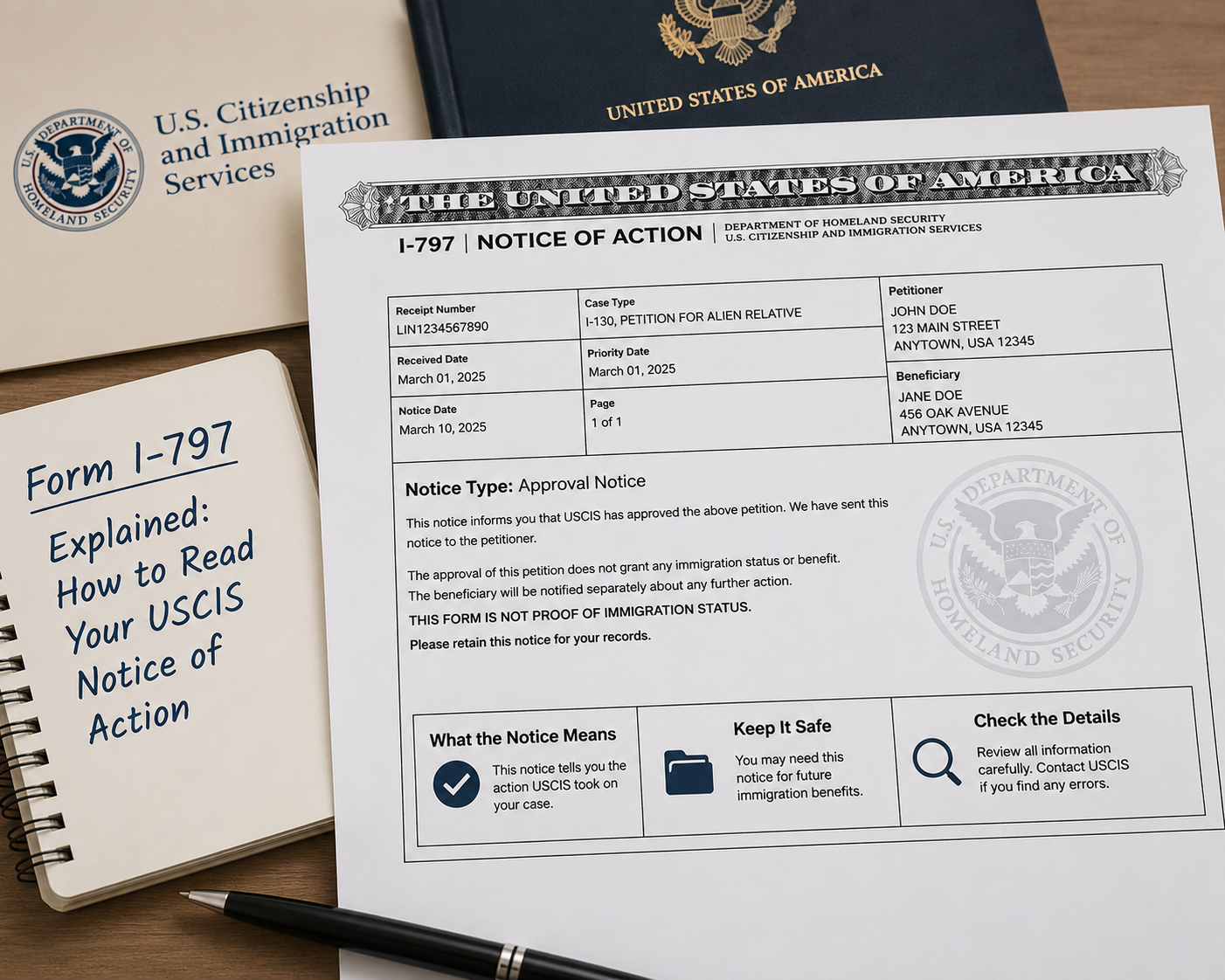
Form I-797 USCIS Notice of Action
Almost everyone who files an immigration case with USCIS will, at some point, open their mailbox and find a Form I-797. It is the agency’s main way of telling you something has happened with your case.

The problem is that a single form number is used for very different messages. One I-797 might simply confirm that your filing arrived. Another might approve your petition, schedule an appointment, or ask for more documents with a hard deadline attached.

Reading these notices correctly is the difference between staying on track and missing a step that could stall or end your case. Here is a plain-English breakdown of what Form I-797 is, the different versions you may receive, and what to look at first.

What Is Form I-797?

Form I-797 is a notice USCIS sends to communicate an action it has taken on your immigration case. Depending on the situation, it can confirm that a filing was received, approve a petition, schedule biometrics or an interview, ask for additional evidence, or let you know your file has moved.

It is important to understand what the notice is not. Most I-797 notices are not a visa, a green card, or proof of work authorization on their own. Whether a notice carries any legal weight depends entirely on what it says and on the underlying benefit behind it.

Why You Might Receive a Form I-797

USCIS issues these notices at many points in the process. The most common reasons include:
  • Filing received: USCIS confirms it accepted your case and assigns a receipt number you can use to track it.
  • Case approved: Formal notice that your petition or application was approved so you can move to the next stage.
  • Appointment scheduled: A request to appear for biometrics or an interview as part of processing.
  • Request for Evidence (RFE): USCIS needs more documentation before it can decide. These notices list exactly what is requested and a firm deadline to respond.
  • Case transferred or reopened: Your file has moved to another office or a closed case is being looked at again, which can change timing.

The Different Versions of Form I-797

USCIS uses several lettered versions of Form I-797, and each one signals something different:
  • I-797, Notice of Action: A general notice, often used to confirm receipt or approval.
  • I-797A: An approval that involves a change or extension of status inside the U.S. It usually includes a new I-94 record.
  • I-797B: Typically an approval for an employment-based or nonimmigrant petition where the visa is obtained abroad.
  • I-797C: Communicates receipts, rejections, file transfers, appointment scheduling, or case reopenings.
  • I-797D: Sent when USCIS issues or replaces a physical document, such as a green card.
  • I-797E: A Request for Evidence issued when more documentation is needed before a decision.
  • I-797F, Transportation Letter: Issued overseas to allow certain applicants to travel to the U.S.

Quick Reference: What Each Version Generally Means

VersionGeneral Meaning
I-797 / I-797CReceipt notices and general updates, including filing confirmations and appointment notices.
I-797A / I-797BApprovals, sometimes with status validity details or consular processing instructions.
I-797DIssuance or delivery of a benefit document, such as a replacement card.
I-797ERequest for Evidence before a decision is made.
I-797FTransportation letter issued overseas to allow travel to the U.S.

What to Check First on Any I-797 Notice

Before you do anything else, slow down and read the notice carefully. Focus on these details:
  • The notice type — is it informational, does it require action, or does it reflect a decision?
  • The receipt number — your key for tracking the case and referencing it in future filings.
  • Names and personal details — confirm spelling, dates of birth, and other information are correct.
  • The action taken or status — understand exactly what USCIS did or is asking for.
  • Any deadline — especially for an RFE or an appointment.
  • Location and appointment details — where and when you need to act.

A Notice Is Not the Same as the Benefit

One of the most useful things to understand is the difference between the notice itself and the immigration benefit behind it.

A Form I-797 confirms or explains what USCIS did. The actual rights — lawful status, work authorization, travel permission, a card, a visa, or an I-94 — come from the approval or document underneath, not from the notice alone. Treating an approval notice as if it were the benefit itself is where many people run into trouble.

Common Mistakes People Make With I-797 Notices

A few recurring errors cause unnecessary problems:
  • Assuming every notice means approval. Many I-797 notices are purely administrative — a receipt or an appointment — and grant no benefit at all.
  • Missing a deadline. RFEs and similar notices come with strict response windows. Missing one can lead to a denial or a closed case.
  • Confusing an approval with authorization. An approved petition does not automatically grant the right to work, travel, or remain in the U.S.
  • Ignoring small errors and inconsistencies. Mismatched names, dates, employers, or priority dates across filings can raise questions later during consular processing or adjustment.
  • Not keeping copies. Failing to organize your notices makes it harder to respond to USCIS and to prepare future applications.

When Legal Guidance Is Worth It

Not every notice requires an attorney, but some situations call for a closer look:
  • The notice affects your eligibility or timing for the next step.
  • You receive a Request for Evidence (RFE) or a Notice of Intent to Deny (NOID), where how you respond directly shapes the outcome.
  • Multiple notices interact over time, or a notice contains errors in names or priority dates.
  • The language is unclear and you are not sure what action, if any, is required.

Misreading a notice can quietly delay a case or cost an opportunity, so when the stakes or the wording are uncertain, it is worth confirming your next move.

Frequently Asked Questions

What is Form I-797?

It is a notice USCIS uses to communicate updates, actions, or decisions on an immigration case.

Does Form I-797 mean my case was approved?

Not necessarily. Some I-797 notices confirm approval, but others simply provide updates, request evidence, or schedule appointments. Read the notice carefully to know which one you have.

What is the difference between I-797 and I-797C?

I-797 is the general notice category, while I-797C is most often used for receipts, appointments, and case updates.

What do I-797A and I-797B mean?

I-797A is typically an approval that includes status validity or a domestic change of status. I-797B is generally an approval for an employment petition where the beneficiary completes visa processing abroad.

What does I-797E mean?

It is a Request for Evidence, meaning USCIS needs more documentation before it can decide your case.

What should I do if I receive an RFE on Form I-797?

Review the request carefully, identify exactly what USCIS is asking for, note the deadline and filing instructions, and consider legal guidance if the request is unclear or affects your eligibility.

When should I talk to an immigration lawyer about a notice?

If the notice involves a deadline, an error or inconsistency, a request for evidence, or unclear next steps, legal guidance can help you respond the right way.

Talk to Keller Law Group About Your USCIS Notice

Form I-797 notices sit at the center of nearly every immigration case, but they do not all mean the same thing. Some confirm a filing, some schedule an appointment, some request evidence, and some reflect an approval tied to a specific benefit. Reading each one correctly is what keeps your case moving.

If you have received a notice you do not fully understand — or one with a deadline, an error, or a request for evidence — we can help you interpret it and plan your next step.

Schedule a consultation today.
Keller Law Group, LLC
Phone: (857) 810-8040
Email: hello@kellerimmigration.com
Hero Image

About Keller Law Group, LLC

Keller Law Group, LLC specializes in immigration law, criminal defense, and personal injury cases. With a commitment to excellence and personalized service, we are here to guide you through every step of the legal process. Visit www.kellerimmigration.com to learn more

Schedule Your Free Discovery Call

Take the first step toward resolving your legal challenges. Book a friendly meet-and-greet to get to know each other (no legal advice at this stage). However, if you’re ready for tailored guidance, schedule a direct legal consultation instead.
We’re here to support you every step of the way!

Schedule Legal Consultation

Connect With Us on Instagram

swiper-image
swiper-image
swiper-image
swiper-image
swiper-image
swiper-image
swiper-image
swiper-image
swiper-image
swiper-image
swiper-image
swiper-image
swiper-image
swiper-image
swiper-image
iphone
View More

We’re Here to Help

Get in Touch with Us

300 Main Street, 1st Floor Worcester, MA 01608

google-maps-logo
Logo

Monday - Friday | 9AM to 5PM

Saturday | Appointment Only

Sunday | Closed

Disclaimer:

In accordance with rules established by the Supreme Judicial Court of Massachusetts, this site must be labeled “advertising.” It is designed to provide general information for clients and those browsing our firm’s website and should not be construed as legal advice, or legal opinion on any specific facts or circumstances. This website is designed for general information only. The information presented at this site should not be construed to be formal legal advice nor the formation of a lawyer/client relationship.

Icon 1Icon 2Icon 3Icon 4Icon 5Icon 6

Powered by AG InfoTech